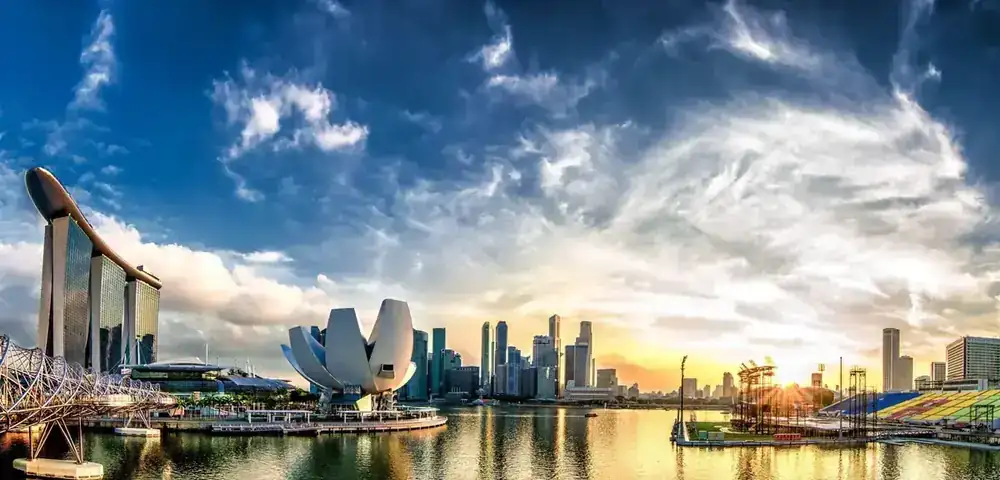
I have been photographing Singapore with what I flatter myself is a discerning eye. The Leica comes with me on morning walks, afternoon expeditions, carefully timed golden-hour pilgrimages. I am building a portfolio, I tell myself. Documenting my experience, capturing the soul of the city through deliberate composition and patient observation.
Yesterday, I uploaded a selection of my work to review on the larger screen, and was confronted with an uncomfortable realization: I have been taking the exact same photographs as everyone else.
There is the obligatory symmetrical shot of the Supertrees at Gardens by the Bay, framed from below to emphasize their absurd height. There is the Marina Bay Sands at dusk, that impossible cantilever catching the last light, water in the foreground providing the requisite reflection. There is the tidy row of shophouses in Chinatown, painted in Instagram-ready pastels, laundry strung between windows in a manner that suggests authenticity.
I have captured, with technical competence and zero originality, the greatest hits of Singapore photography. My compositions could be used in a tourism board campaign. They probably have been, thousands of times over, by thousands of other people with cameras and similar aspirations toward artistic documentation.
The problem, I suspect, is that I am still seeing Singapore as a visitor sees it. My eye is drawn to what is already iconic, already validated as photographable. I point my lens at the things that have been designated as worth pointing lenses at. This is not observation; this is replication with better equipment.
Even my "street photography" falls into well-worn grooves. The hawker uncle preparing char kway teow, smoke rising in atmospheric backlight. The elderly woman at the wet market, weighing vegetables on a scale that looks appropriately analog. These are fine photographs. They are also profoundly predictable photographs, the kind that every photography workshop in Singapore produces by the dozen.
The lilies remain my only original subject, and even that claim is dubious. I photograph them because I understand them, because I have spent enough time in their presence to see past the obvious angles. But point my lens at the city, and I revert immediately to the tourist's gaze: capturing landmarks, seeking the picturesque, documenting the already-documented.
I wonder how long one must live in a place before one stops seeing it through the lens of arrival, before the eye calibrates to something other than greatest hits and photographic clichés. I have been here two months. The camera still sees Singapore as a destination, a collection of frames to be captured and catalogued. Perhaps in another six months, another year, I will point my lens at something that has not already been photographed a million times. Until then, I am simply adding to the archive, one technically proficient, aesthetically predictable image at a time.